Module 1: Introduction to Safety Management in Healthcare
This module provides an overview of safety management principles and practices in healthcare settings. Topics include safety culture, risk management, and quality improvement initiatives.
This comprehensive course is designed for healthcare professionals to implement unbroken standards in healthcare, ensuring a safe and healthy environment for patients and staff. It covers the main principles of safety management, risk assessment, and control measures, making it unique and beneficial for participants. The course provides key benefits, including enhanced knowledge and skills, improved patient outcomes, and reduced risk of adverse events.
4.4/5
|96 reviews
|418 students enrolled
Comprehensive, industry-recognized certification that enhances your professional credentials
Self-paced online learning with 24/7 access to course materials for maximum flexibility
Practical knowledge and skills that can be immediately applied in your workplace
This module provides an overview of safety management principles and practices in healthcare settings. Topics include safety culture, risk management, and quality improvement initiatives.
This module focuses on identifying potential hazards and assessing risks in healthcare settings. Topics include hazard recognition, risk assessment tools, and control measures.
This module provides you with practical frameworks and methodologies for conducting thorough risk assessments in various workplace settings. You'll learn evidence-based approaches to identify, evaluate, and prioritize potential hazards.
Effective risk assessment has been shown to reduce workplace injuries by up to 70% when implemented correctly, making this a critical skill for safety professionals.
This module covers the development and implementation of safety management systems and policies in healthcare settings. Topics include policy development, procedure writing, and compliance monitoring.
This module focuses on quality improvement initiatives and patient safety strategies in healthcare settings. Topics include quality metrics, patient satisfaction, and safety culture.
This module covers effective communication and teamwork strategies in healthcare settings. Topics include communication models, teamwork principles, and conflict resolution.
This module focuses on leadership and management principles and practices in healthcare safety. Topics include leadership styles, management theories, and strategic planning.
This programme includes comprehensive study materials designed to support your learning journey and offers maximum flexibility, allowing you to study at your own pace and at a time that suits you best.
You will have access to online podcasts with expert audio commentary.
In addition, you'll benefit from student support via automatic live chat.
Assessments for the programme are conducted online through multiple-choice questions that are carefully designed to evaluate your understanding of the course content.
These assessments are time-bound, encouraging learners to think critically and manage their time effectively while demonstrating their knowledge in a structured and efficient manner.
['The demand for healthcare professionals with expertise in safety management and quality improvement is increasing. This course provides opportunities for career advancement and professional growth in healthcare safety.', 'Healthcare organizations are seeking professionals who can lead and manage safety initiatives, develop and implement safety policies, and evaluate and monitor safety performance metrics.', 'The career prospects for healthcare professionals with expertise in safety management and quality improvement are excellent, with opportunities for advancement to leadership and management roles.']
['The career path for healthcare professionals with expertise in safety management and quality improvement typically begins with entry-level positions in healthcare organizations.', 'With experience and further education, professionals can advance to leadership and management roles, such as safety manager, quality improvement manager, or patient safety officer.', 'Opportunities for professional development and growth are available through continuing education, certification programs, and professional associations.']
Responsible for developing and implementing patient safety initiatives, evaluating and monitoring safety performance metrics, and leading root cause analysis and corrective action plans.
Responsible for developing and implementing quality improvement initiatives, evaluating and monitoring quality metrics, and leading quality improvement projects.
Responsible for developing and implementing safety policies and procedures, evaluating and monitoring safety performance metrics, and leading safety initiatives and projects.
['Networking opportunities through professional associations and conferences', 'Professional certifications, such as Certified Professional in Patient Safety (CPPS) or Certified Quality Improvement Associate (CQIA)', "Further education paths, such as master's or doctoral degrees in healthcare safety or quality improvement", 'Industry recognition through awards and publications']
Clinical Director
"This course has been instrumental in helping me implement unbroken standards in our hospital, particularly in risk assessment and control measures, which has significantly reduced the risk of adverse events. I can now confidently lead my team in providing a safer environment for our patients."
Infection Control Specialist
"I gained valuable knowledge on safety management principles and strategies to mitigate risks in healthcare settings, which I've already applied to improve patient outcomes and reduce hospital-acquired infections in our facility."
Quality Assurance Manager
"The course provided me with a comprehensive understanding of unbroken standards in healthcare, enabling me to develop and implement effective safety protocols that have enhanced the overall quality of care in our hospital."
Patient Safety Officer
"I appreciated the course's focus on practical applications of safety management principles, which has equipped me with the skills to conduct thorough risk assessments and develop targeted interventions to prevent adverse events in our healthcare system."
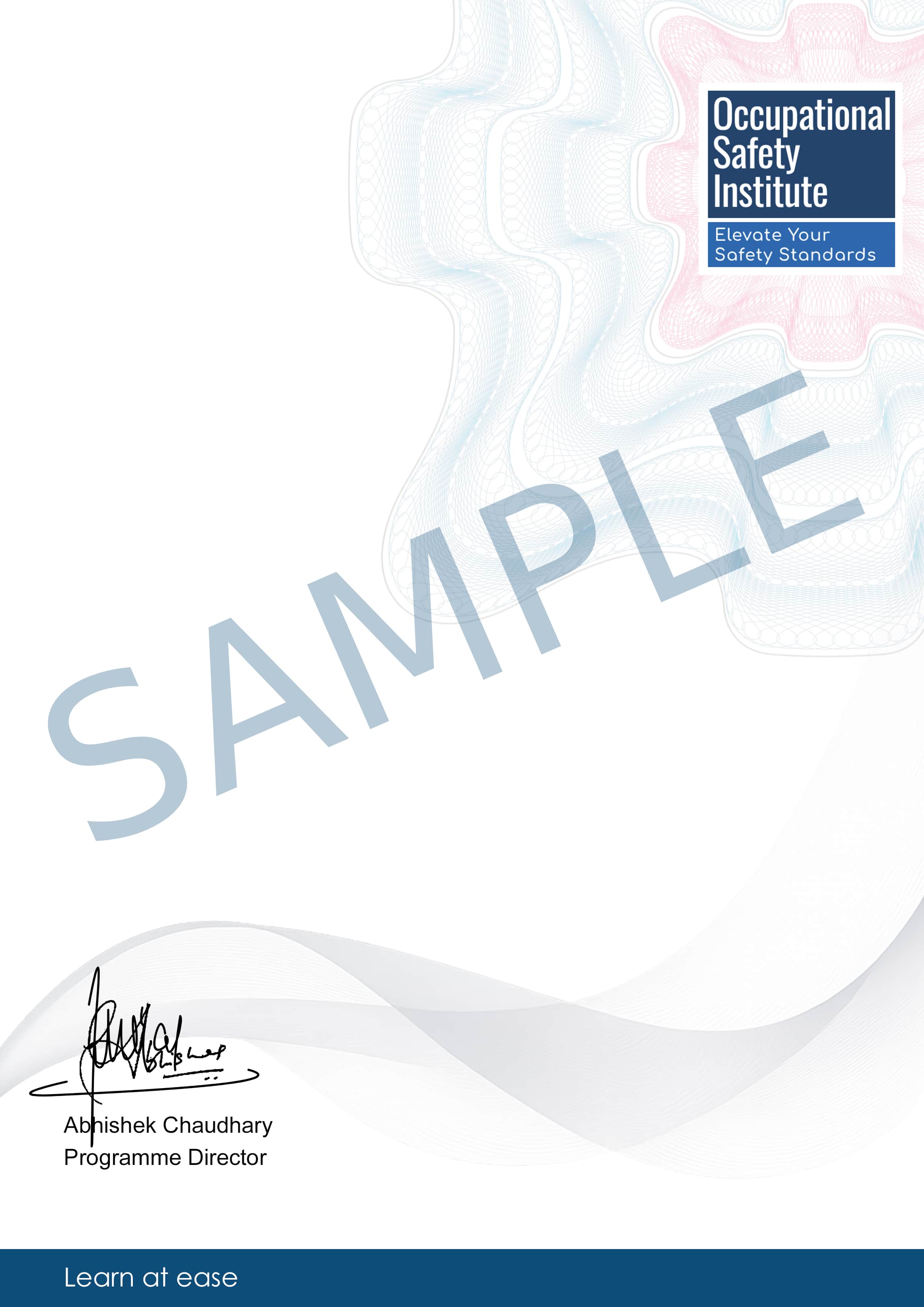
Upon successful completion of this course, you will receive a certificate similar to the one shown below:
No specific prior qualifications are required. However, basic literacy and numeracy skills are essential for successful completion of the course.
The course is self-paced and flexible. Most learners complete it within 1 to 2 months by dedicating 4 to 6 hours per week.
This course is not accredited by a recognised awarding body and is not regulated by an official institution. It is designed for personal and professional development and is not intended to replace or serve as an equivalent to a formal degree or diploma.
This fully online programme includes comprehensive study materials and a range of support options to enhance your learning experience: - Online quizzes (multiple choice questions) - Audio podcasts (expert commentary) - Live student support via chat The course offers maximum flexibility, allowing you to study at your own pace, on your own schedule.
Yes, the course is delivered entirely online with 24/7 access to learning materials. You can study at your convenience from any device with an internet connection.
中央パッケージ Regulatory Compliance and Health Standards Implementation
Course about 中央パッケージ Regulatory Compliance and Health Stand…
Occupational Health and Safety Compliance Essentials
This course provides a comprehensive overview of occupation…
Underwriting Guidelines for Health and Safety Compliance Training
This course provides in-depth understanding of underwriting…
Fire Safety Procedures for Hotels and Hospitality
This course provides in-depth knowledge and practical skill…
Disclaimer: This certificate is not intended to replace or serve as an equivalent to obtaining a formal degree or diploma. This programme is structured for professional enrichment and is offered independently of any formal accreditation framework.