Module 1: Introduction to Safety Management
This module provides an overview of the fundamental principles of safety management, including the importance of safety, safety management systems, and the role of safety professionals.
This course provides a comprehensive overview of safety management, focusing on risk assessment and mitigation strategies. It is designed for professionals seeking to improve their knowledge and skills in this area, with a unique approach to applying AI-generated insights. Participants will gain practical knowledge and skills to enhance their career prospects and contribute to a safer work environment.
4.4/5
|96 reviews
|418 students enrolled
Comprehensive, industry-recognized certification that enhances your professional credentials
Self-paced online learning with 24/7 access to course materials for maximum flexibility
Practical knowledge and skills that can be immediately applied in your workplace
This module provides an overview of the fundamental principles of safety management, including the importance of safety, safety management systems, and the role of safety professionals.
This module covers the principles of hazard identification and risk assessment, including the use of tools and techniques such as hazard matrices and risk assessment templates.
This module provides you with practical frameworks and methodologies for conducting thorough risk assessments in various workplace settings. You'll learn evidence-based approaches to identify, evaluate, and prioritize potential hazards.
Effective risk assessment has been shown to reduce workplace injuries by up to 70% when implemented correctly, making this a critical skill for safety professionals.
This module explores the various mitigation strategies that can be implemented to minimize risks, including engineering controls, administrative controls, and personal protective equipment.
This module covers the development of safety plans and procedures, including emergency response plans, spill response plans, and fire safety plans.
This module introduces the application of AI-generated insights in safety management, including the use of machine learning algorithms and data analytics to predict and prevent safety incidents.
This module covers the importance of communication and stakeholder engagement in safety management, including the development of safety communication plans and stakeholder engagement strategies.
This programme includes comprehensive study materials designed to support your learning journey and offers maximum flexibility, allowing you to study at your own pace and at a time that suits you best.
You will have access to online podcasts with expert audio commentary.
In addition, you'll benefit from student support via automatic live chat.
Assessments for the programme are conducted online through multiple-choice questions that are carefully designed to evaluate your understanding of the course content.
These assessments are time-bound, encouraging learners to think critically and manage their time effectively while demonstrating their knowledge in a structured and efficient manner.
The demand for safety professionals is increasing globally, driven by the need for organizations to minimize risks and ensure compliance with safety regulations. Professionals with expertise in safety management can pursue a wide range of career opportunities, from entry-level positions to senior management roles. The field of safety management offers a high level of job satisfaction, as safety professionals play a critical role in protecting people, the environment, and property.
The career path for safety professionals typically begins with entry-level positions, such as safety officers or safety coordinators. With experience and additional education, safety professionals can progress to senior roles, such as safety managers or directors of safety. The field of safety management is constantly evolving, with new technologies and methodologies being developed to improve safety performance. As a result, safety professionals must commit to ongoing learning and professional development to stay current with industry trends and best practices.
Responsible for developing and implementing safety management systems, conducting risk assessments, and providing safety training to employees
Conducts risk assessments to identify hazards and develops mitigation strategies to minimize risks
Develops and implements EHS programs to minimize the impact of organizational activities on the environment and ensure compliance with EHS regulations
In addition to the career opportunities outlined above, safety professionals can also pursue opportunities in consulting, training, and education. Many organizations also offer professional certifications, such as the Certified Safety Professional (CSP) or the Occupational Health and Safety Technologist (OHST), which can enhance career prospects and demonstrate expertise in the field. Furthermore, safety professionals can participate in industry associations and networking events to stay current with industry trends and best practices.
Environmental Health and Safety Manager
"This course helped me develop a comprehensive risk assessment framework for our company's green technology operations, and I'm now able to identify and mitigate potential hazards more effectively. The AI-generated insights were particularly valuable in informing our safety management strategy."
Sustainability Consultant
"The unique approach to applying AI-generated insights in this course enabled me to enhance my skills in assessing and mitigating risks associated with green technology implementations, and I'm now better equipped to support my clients in achieving their sustainability goals."
Operations Manager - Renewable Energy
"I gained practical knowledge on how to conduct thorough risk assessments for our solar panel manufacturing facility, and the course's focus on mitigation strategies has helped me reduce incident rates and improve overall safety performance."
Green Building Specialist
"The course provided me with a deeper understanding of how to integrate safety management principles into green building design and construction, and I'm now able to design more effective risk mitigation strategies that balance sustainability goals with safety requirements."
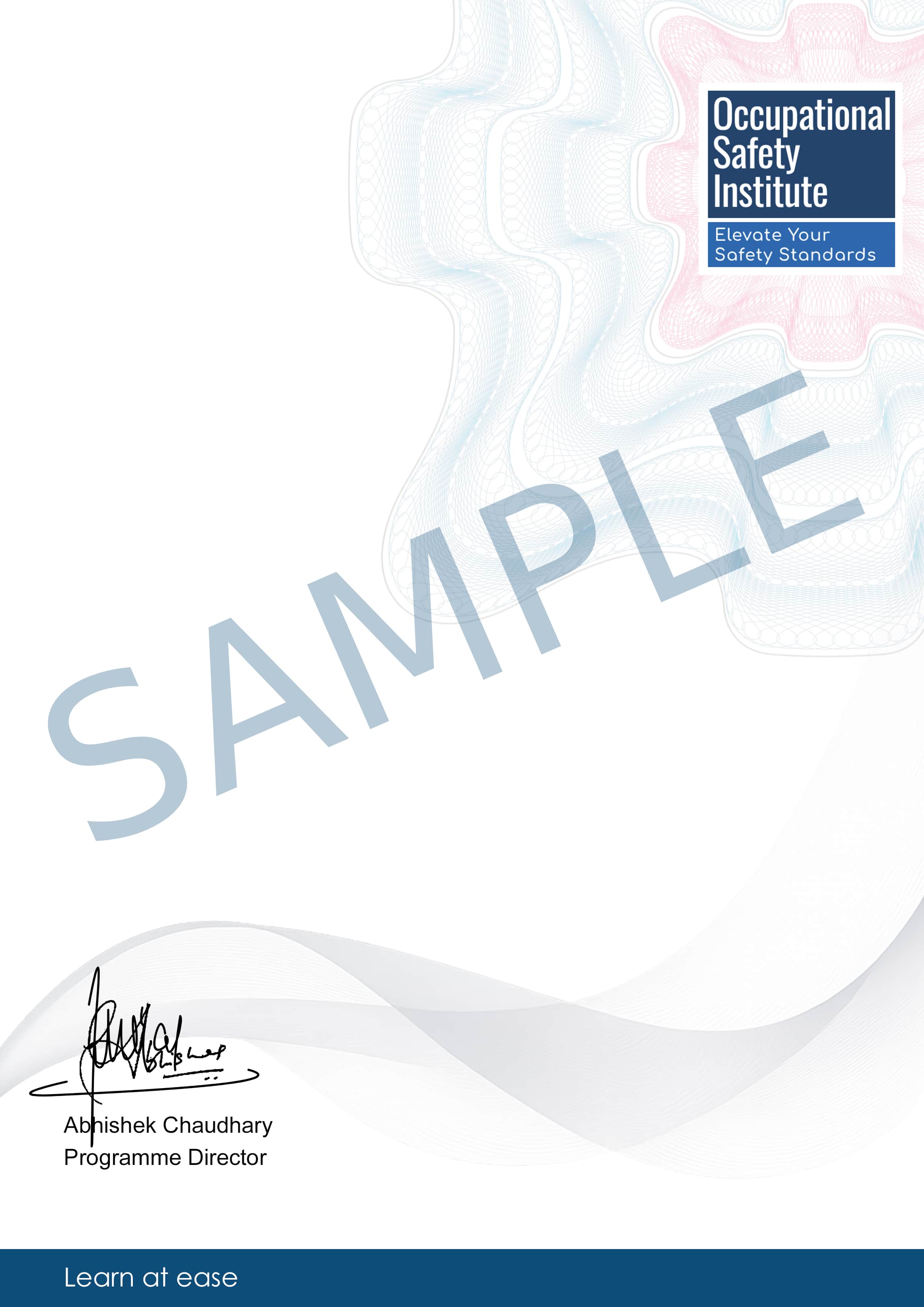
Upon successful completion of this course, you will receive a certificate similar to the one shown below:
No specific prior qualifications are required. However, basic literacy and numeracy skills are essential for successful completion of the course.
The course is self-paced and flexible. Most learners complete it within 1 to 2 months by dedicating 4 to 6 hours per week.
This course is not accredited by a recognised awarding body and is not regulated by an official institution. It is designed for personal and professional development and is not intended to replace or serve as an equivalent to a formal degree or diploma.
This fully online programme includes comprehensive study materials and a range of support options to enhance your learning experience: - Online quizzes (multiple choice questions) - Audio podcasts (expert commentary) - Live student support via chat The course offers maximum flexibility, allowing you to study at your own pace, on your own schedule.
Yes, the course is delivered entirely online with 24/7 access to learning materials. You can study at your convenience from any device with an internet connection.
Resource Management for Effective Emergency Response
This course focuses on equipping professionals with the nec…
Health and Safety New Account Sign-In Procedures Training
This course provides in-depth training on Health and Safety…
Data Security Measures for Business Intelligence in Health and Safety
This course focuses on data security measures for business …
バイク 輪留め Safety Inspection and Maintenance Training
This course provides in-depth training on bike wheel safety…
Disclaimer: This certificate is not intended to replace or serve as an equivalent to obtaining a formal degree or diploma. This programme is structured for professional enrichment and is offered independently of any formal accreditation framework.